Mini columns: ideal column replacement for RNA extraction or RNA cleaning kits, such as all kinds of Qiagen's RNeasy kits, to purify RNA from tissue, cells, blood, yeast and bacteria. Elution volume 35-50 µl.
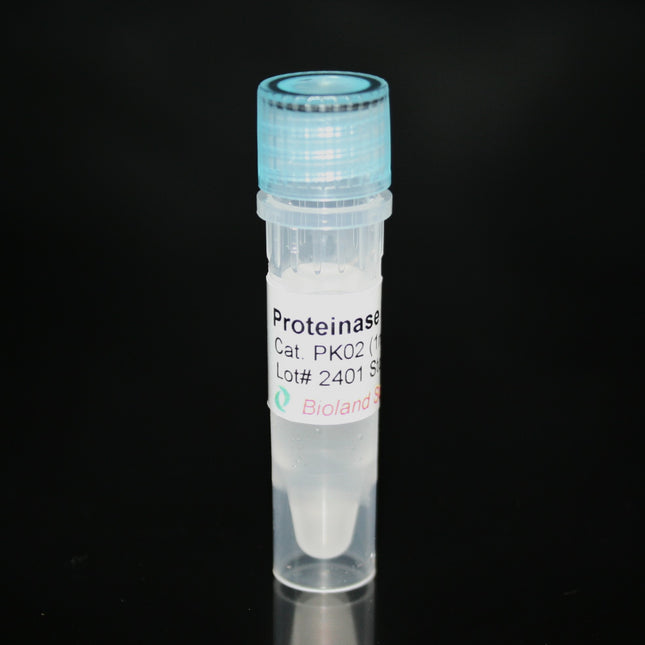
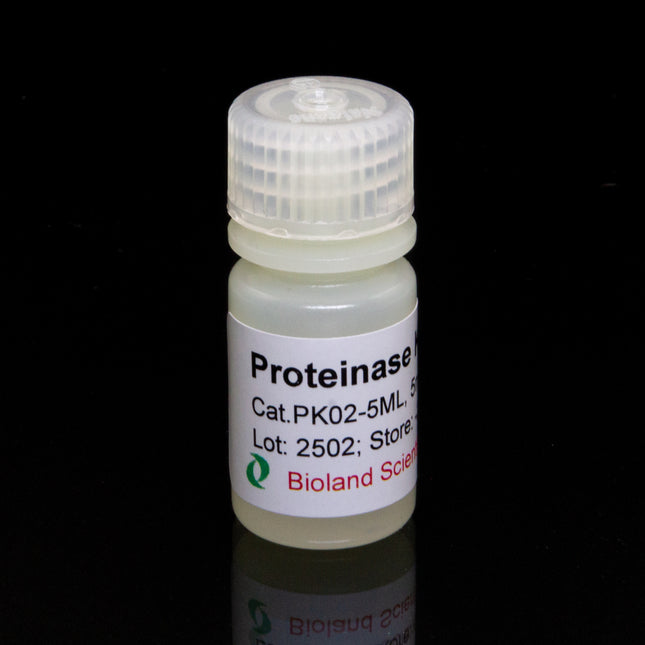
Proteinase K is an endolytic protease that cleaves peptide bonds at the carboxylic sides of aliphatic, aromatic or hydrophobic amino acids. The Proteinase K is classified as a serine protease. The smallest peptide to be hydrolyzed by this enzyme is a tetrapeptide.
Specific Activity: 40 U/mg protein
Molecular Weight: 28.9 kDa monomer
Source: Pichia pastoris cells with a cloned gene encoding Tritirachium album endolytic protease (Proteinase K).
Applications
Isolation of genomic DNA from cultured cells and tissues
Removal of DNases and RNases when isolating DNA and RNA from tissues or cell lines
Determination of enzyme localization
Improving cloning efficiency of PCR products
Quality Control
DNase Activity: None detectable enzyme activity with λ DNA after 6 hrs incubation at 37ºC.
RNase Activity: None detectable ribonuclease activity after 16 hrs incubation at 25ºC.
Dilution Buffer
50 mM Tris-HCl (pH 7.5), containing 5 mM calcium chloride and 50% (v/v) glycerol.
Definition of Activity Unit
One unit of the enzyme liberates Folin-positive amino acids and peptides corresponding to 1 µmol tyrosine in 1 min at 37°C using denatured hemoglobin as substrate.Enzyme activity is assayed in the following mixture: 0.08 M potassium phosphate (pH 7.5), 5 M urea, 4 mM NaCl, 3 mM CaCl2 and 16.7 mg/ml hemoglobin.
Storage
For long time storage, store the Proteinase K powder at 4ºC and solution at -20°C.
Inhibition and Inactivation
Inhibitors: Proteinase K is not inactivated by metal chelators, by thiol-reactive reagents or by specific trypsin and chymotrypsin inhibitors. Phenylmethylsulfonyl fluoride and diisopropyl phosphorofluoridate completely inhibit the enzyme.
Inactivated by heating at 95°C for 10 minutes.
Other Note:
Optimum activity at 50-55°C.
Rapid denaturation of enzyme occurs at temperatures above 65°C.
The recommended working concentration for Proteinase K is 0.05-1 mg/ml. The activity of the enzyme is stimulated by 0.2-1% SDS or by 1-4 M urea.
Ca2+ protects Proteinase K against autolysis, increases the thermal stability and has a regulatory function for the substrate binding site of Proteinase K.
Stable over a wide pH range: 4.0-12.5, optimum pH 7.5-8.0.
The Vacuum Manifolds are specially designed for high-throughput nucleic acid purification, solid phase extraction, protein precipitation, Oligo synthesis and other applications. The manifolds are adapted to 48/96/384 well plates and Luer-inlet columns to eliminate repetition of pipetting and centrifugation in traditional nucleic acid extraction methods.
Features
Reliability: made of anti-corrosion and durable material
Uniformity: the compact design ensures uniform flow rate during extraction at negative pressure
Convenience: eliminate repeated operations of centrifugation and pipetting in traditional methods to improve efficiency
Applications
Nucleic acid extraction, solid phase extraction, protein precipitation, QuEChERS, phospholipids removal, Oligo synthesis of deprotection, ammonolysis and other processes etc.