
Products
-
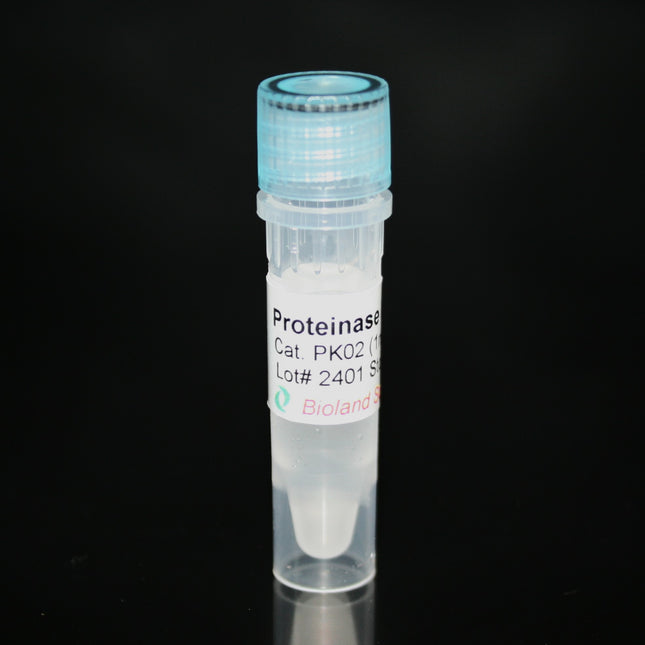
Proteinase K Solution (20mg/ml, 1ml)
SKU: PK02-1MLProteinase K is an endolytic protease that cleaves peptide bonds at the carboxylic sides of aliphatic, aromatic or hydrophobic amino acids. The Proteinase K is classified as a serine protease. The smallest peptide to be hydrolyzed by this enzyme is a tetrapeptide. Specific Activity: 40 U/mg protein Molecular Weight: 28.9 kDa monomer Source: Pichia pastoris cells with a cloned gene encoding Tritirachium album endolytic protease (Proteinase K). Applications Isolation of genomic DNA from cultured cells and tissues Removal of DNases and RNases when isolating DNA and RNA from tissues or cell lines Determination of enzyme localization Improving cloning efficiency of PCR products Quality Control DNase Activity: None detectable enzyme activity with λ DNA after 6 hrs incubation at 37ºC. RNase Activity: None detectable ribonuclease activity after 16 hrs incubation at 25ºC. Dilution Buffer 50 mM Tris-HCl (pH 7.5), containing 5 mM calcium chloride and 50% (v/v) glycerol. Definition of Activity Unit One unit of the enzyme liberates Folin-positive amino acids and peptides corresponding to 1 µmol tyrosine in 1 min at 37°C using denatured hemoglobin as substrate.Enzyme activity is assayed in the following mixture: 0.08 M potassium phosphate (pH 7.5), 5 M urea, 4 mM NaCl, 3 mM CaCl2 and 16.7 mg/ml hemoglobin. Storage For long time storage, store the Proteinase K powder at 4ºC and solution at -20°C. Inhibition and Inactivation Inhibitors: Proteinase K is not inactivated by metal chelators, by thiol-reactive reagents or by specific trypsin and chymotrypsin inhibitors. Phenylmethylsulfonyl fluoride and diisopropyl phosphorofluoridate completely inhibit the enzyme. Inactivated by heating at 95°C for 10 minutes. Other Note: Optimum activity at 50-55°C. Rapid denaturation of enzyme occurs at temperatures above 65°C. The recommended working concentration for Proteinase K is 0.05-1 mg/ml. The activity of the enzyme is stimulated by 0.2-1% SDS or by 1-4 M urea. Ca2+ protects Proteinase K against autolysis, increases the thermal stability and has a regulatory function for the substrate binding site of Proteinase K. Stable over a wide pH range: 4.0-12.5, optimum pH 7.5-8.0.
$31.80
-
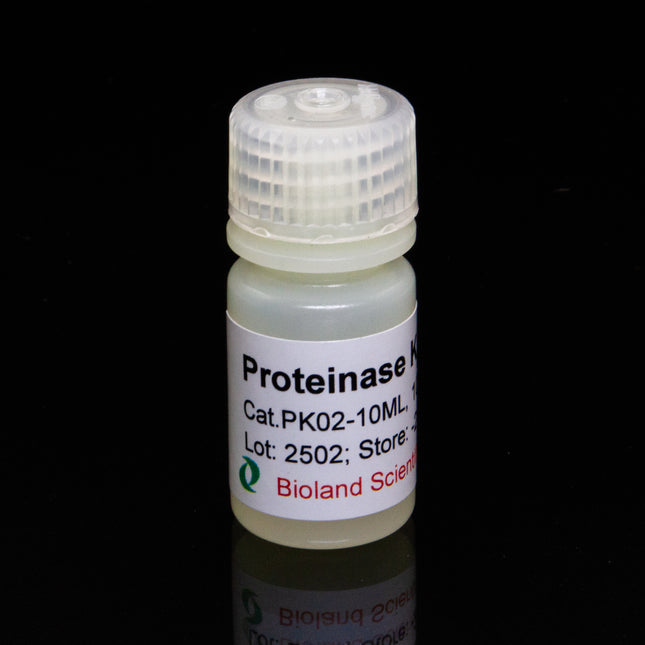
Proteinase K Solution, 20mg/ml (10 ml)
SKU: PK02-10MLProteinase K is an endolytic protease that cleaves peptide bonds at the carboxylic sides of aliphatic, aromatic or hydrophobic amino acids. The Proteinase K is classified as a serine protease. The smallest peptide to be hydrolyzed by this enzyme is a tetrapeptide. Specific Activity: 40 U/mg protein Molecular Weight: 28.9 kDa monomer Source: Pichia pastoris cells with a cloned gene encoding Tritirachium album endolytic protease (Proteinase K). Applications Isolation of genomic DNA from cultured cells and tissues Removal of DNases and RNases when isolating DNA and RNA from tissues or cell lines Determination of enzyme localization Improving cloning efficiency of PCR products Quality Control DNase Activity: None detectable enzyme activity with λ DNA after 6 hrs incubation at 37ºC. RNase Activity: None detectable ribonuclease activity after 16 hrs incubation at 25ºC. Dilution Buffer 50 mM Tris-HCl (pH 7.5), containing 5 mM calcium chloride and 50% (v/v) glycerol. Definition of Activity Unit One unit of the enzyme liberates Folin-positive amino acids and peptides corresponding to 1 µmol tyrosine in 1 min at 37°C using denatured hemoglobin as substrate.Enzyme activity is assayed in the following mixture: 0.08 M potassium phosphate (pH 7.5), 5 M urea, 4 mM NaCl, 3 mM CaCl2 and 16.7 mg/ml hemoglobin. Storage For long time storage, store the Proteinase K powder at 4ºC and solution at -20°C. Inhibition and Inactivation Inhibitors: Proteinase K is not inactivated by metal chelators, by thiol-reactive reagents or by specific trypsin and chymotrypsin inhibitors. Phenylmethylsulfonyl fluoride and diisopropyl phosphorofluoridate completely inhibit the enzyme. Inactivated by heating at 95°C for 10 minutes. Other Note: Optimum activity at 50-55°C. Rapid denaturation of enzyme occurs at temperatures above 65°C. The recommended working concentration for Proteinase K is 0.05-1 mg/ml. The activity of the enzyme is stimulated by 0.2-1% SDS or by 1-4 M urea. Ca2+ protects Proteinase K against autolysis, increases the thermal stability and has a regulatory function for the substrate binding site of Proteinase K. Stable over a wide pH range: 4.0-12.5, optimum pH 7.5-8.0.
$188.20
-
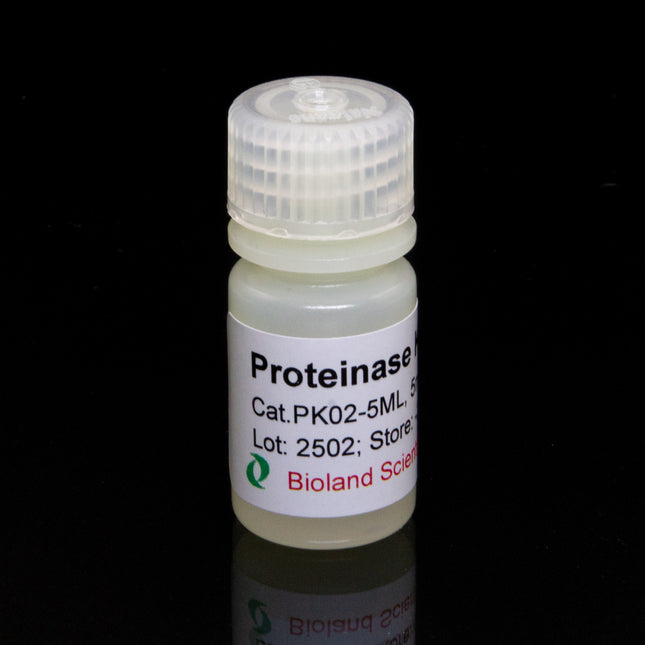
Proteinase K Solution, 20mg/ml (5 ml)
SKU: PK02-5MLProteinase K is an endolytic protease that cleaves peptide bonds at the carboxylic sides of aliphatic, aromatic or hydrophobic amino acids. The Proteinase K is classified as a serine protease. The smallest peptide to be hydrolyzed by this enzyme is a tetrapeptide. Specific Activity: 40 U/mg protein Molecular Weight: 28.9 kDa monomer Source: Pichia pastoris cells with a cloned gene encoding Tritirachium album endolytic protease (Proteinase K). Applications Isolation of genomic DNA from cultured cells and tissues Removal of DNases and RNases when isolating DNA and RNA from tissues or cell lines Determination of enzyme localization Improving cloning efficiency of PCR products Quality Control DNase Activity: None detectable enzyme activity with λ DNA after 6 hrs incubation at 37ºC. RNase Activity: None detectable ribonuclease activity after 16 hrs incubation at 25ºC. Dilution Buffer 50 mM Tris-HCl (pH 7.5), containing 5 mM calcium chloride and 50% (v/v) glycerol. Definition of Activity Unit One unit of the enzyme liberates Folin-positive amino acids and peptides corresponding to 1 µmol tyrosine in 1 min at 37°C using denatured hemoglobin as substrate.Enzyme activity is assayed in the following mixture: 0.08 M potassium phosphate (pH 7.5), 5 M urea, 4 mM NaCl, 3 mM CaCl2 and 16.7 mg/ml hemoglobin. Storage For long time storage, store the Proteinase K powder at 4ºC and solution at -20°C. Inhibition and Inactivation Inhibitors: Proteinase K is not inactivated by metal chelators, by thiol-reactive reagents or by specific trypsin and chymotrypsin inhibitors. Phenylmethylsulfonyl fluoride and diisopropyl phosphorofluoridate completely inhibit the enzyme. Inactivated by heating at 95°C for 10 minutes. Other Note: Optimum activity at 50-55°C. Rapid denaturation of enzyme occurs at temperatures above 65°C. The recommended working concentration for Proteinase K is 0.05-1 mg/ml. The activity of the enzyme is stimulated by 0.2-1% SDS or by 1-4 M urea. Ca2+ protects Proteinase K against autolysis, increases the thermal stability and has a regulatory function for the substrate binding site of Proteinase K. Stable over a wide pH range: 4.0-12.5, optimum pH 7.5-8.0.
$100.00
-
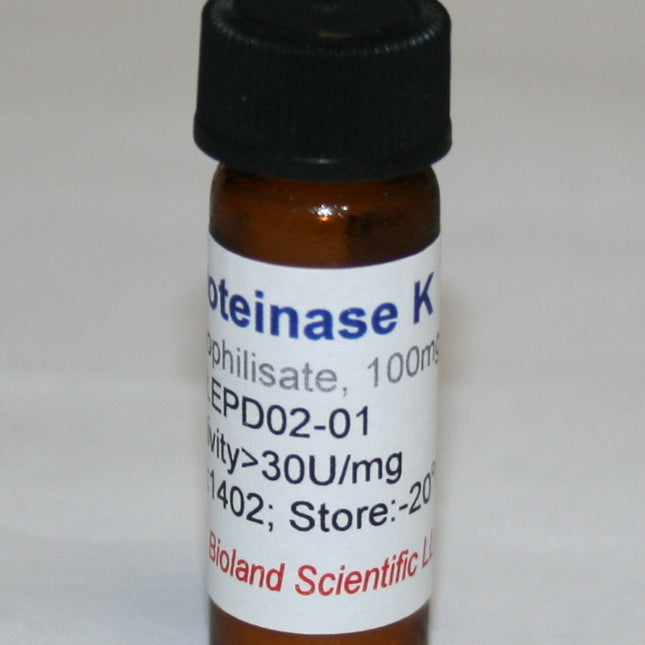
Proteinase K, Lyophilisate (1 g)
SKU: PK01-1GProteinase K is an endolytic protease that cleaves peptide bonds at the carboxylic sides of aliphatic, aromatic or hydrophobic amino acids. The Proteinase K is classified as a serine protease. The smallest peptide to be hydrolyzed by this enzyme is a tetrapeptide. Specific Activity: 40 U/mg protein Molecular Weight: 28.9 kDa monomer Source: Pichia pastoris cells with a cloned gene encoding Tritirachium album endolytic protease (Proteinase K). Applications Isolation of genomic DNA from cultured cells and tissues Removal of DNases and RNases when isolating DNA and RNA from tissues or cell lines Determination of enzyme localization Improving cloning efficiency of PCR products Quality Control DNase Activity: None detectable enzyme activity with λ DNA after 6 hrs incubation at 37°C. RNase Activity: None detectable ribonuclease activity after 16 hrs incubation at 25°C. Dilution Buffer 50 mM Tris-HCl (pH 7.5), containing 5 mM calcium chloride and 50% (v/v) glycerol. Definition of Activity Unit One unit of the enzyme liberates Folin-positive amino acids and peptides corresponding to 1 µmol tyrosine in 1 min at 37°C using denatured hemoglobin as substrate.Enzyme activity is assayed in the following mixture: 0.08 M potassium phosphate (pH 7.5), 5 M urea, 4 mM NaCl, 3 mM CaCl2 and 16.7 mg/ml hemoglobin. Storage For long time storage, store the Proteinase K powder at 4ºC and solution at -20°C. Inhibition and Inactivation Inhibitors: Proteinase K is not inactivated by metal chelators, by thiol-reactive reagents or by specific trypsin and chymotrypsin inhibitors. Phenylmethylsulfonyl fluoride and diisopropyl phosphorofluoridate completely inhibit the enzyme. Inactivated by heating at 95°C for 10 minutes. Other Note: Optimum activity at 50-55°C. Rapid denaturation of enzyme occurs at temperatures above 65°C. The recommended working concentration for Proteinase K is 0.05-1 mg/ml. The activity of the enzyme is stimulated by 0.2-1% SDS or by 1-4 M urea. Ca2+ protects Proteinase K against autolysis, increases the thermal stability and has a regulatory function for the substrate binding site of Proteinase K. Stable over a wide pH range: 4.0-12.5, optimum pH 7.5-8.0.
$411.80
-
Proteinase K, Lyophilisate (100 mg)
SKU: PK01-100MGProteinase K is an endolytic protease that cleaves peptide bonds at the carboxylic sides of aliphatic, aromatic or hydrophobic amino acids. The Proteinase K is classified as a serine protease. The smallest peptide to be hydrolyzed by this enzyme is a tetrapeptide. Specific Activity: 40 U/mg protein Molecular Weight: 28.9 kDa monomer Source: Pichia pastoris cells with a cloned gene encoding Tritirachium album endolytic protease (Proteinase K). Applications Isolation of genomic DNA from cultured cells and tissues Removal of DNases and RNases when isolating DNA and RNA from tissues or cell lines Determination of enzyme localization Improving cloning efficiency of PCR products Quality Control DNase Activity: None detectable enzyme activity with λ DNA after 6 hrs incubation at 37°C. RNase Activity: None detectable ribonuclease activity after 16 hrs incubation at 25°C. Dilution Buffer 50 mM Tris-HCl (pH 7.5), containing 5 mM calcium chloride and 50% (v/v) glycerol. Definition of Activity Unit One unit of the enzyme liberates Folin-positive amino acids and peptides corresponding to 1 µmol tyrosine in 1 min at 37°C using denatured hemoglobin as substrate.Enzyme activity is assayed in the following mixture: 0.08 M potassium phosphate (pH 7.5), 5 M urea, 4 mM NaCl, 3 mM CaCl2 and 16.7 mg/ml hemoglobin. Storage For long time storage, store the Proteinase K powder at 4ºC and solution at -20°C. Inhibition and Inactivation Inhibitors: Proteinase K is not inactivated by metal chelators, by thiol-reactive reagents or by specific trypsin and chymotrypsin inhibitors. Phenylmethylsulfonyl fluoride and diisopropyl phosphorofluoridate completely inhibit the enzyme. Inactivated by heating at 95°C for 10 minutes. Other Note: Optimum activity at 50-55°C. Rapid denaturation of enzyme occurs at temperatures above 65°C. The recommended working concentration for Proteinase K is 0.05-1 mg/ml. The activity of the enzyme is stimulated by 0.2-1% SDS or by 1-4 M urea. Ca2+ protects Proteinase K against autolysis, increases the thermal stability and has a regulatory function for the substrate binding site of Proteinase K. Stable over a wide pH range: 4.0-12.5, optimum pH 7.5-8.0.
$58.80
-
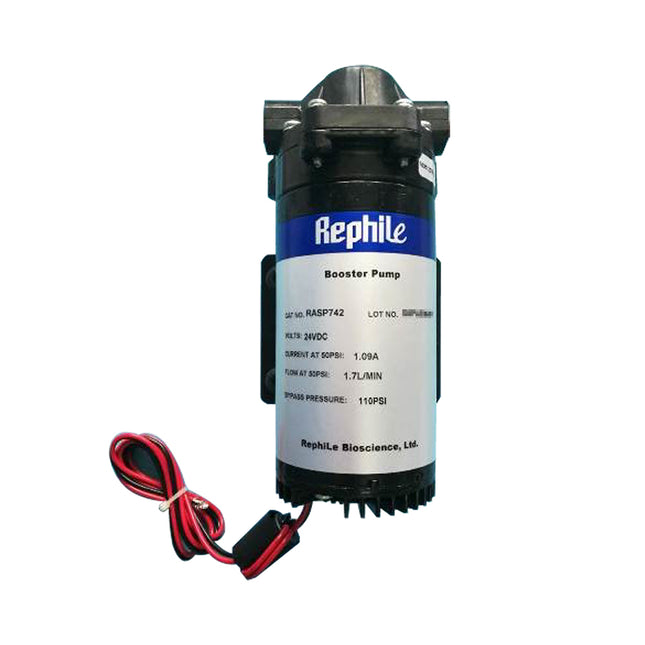
Recirculation pump, 24VDC (1 Count)
SKU: RASP743Distribution Pump, 24VDC is used to allow water dispensing and recirculation. Specifications Operating voltage 24 VDC ± 5% Input pressure 0.2 – 6.0 bar Output pressure 4.0 – 6.5 bar Operating temperature < 60 °C Fitting Inlet and outlet are 8 mm quick connectors Suitable Genie water systems: Genie G Genie U Genie A Genie E Genie R Genie PURIST
$570.00
-
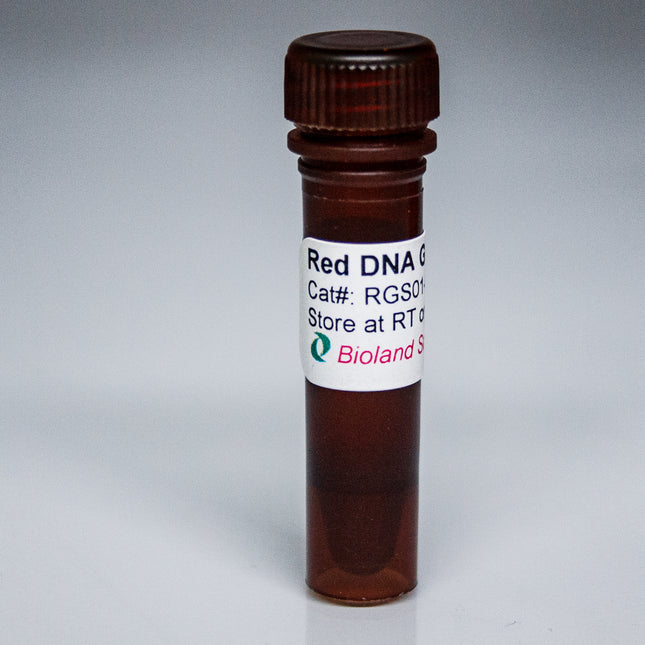
Red DNA Gel Stain (10,000x, 1.0 ml) For UV Light
SKU: RGS01-01Red DNA Gel Stain is a new and safe class fluorescent dye, used for agarose gel or polyacrylamide gel staining to visualize DNA or RNA. It is a safe replacement of Ethidium Bromide, a potent mutagen. Red DNA Gel Stain showed negative results in Ames test, indicating that it's not carcinogenic. Red DNA Gel Stain is used the same way as Ethidium Bromide. It emits Red fluorescence when bound to DNA under UV light. It has the excitation maxima: 450nm. Protocol Prepare a 50 ml agarose or polyacrylamide solution. Add 5 ul Safe DNA Gel Stain to the gel solution. Mix gently; the solution should have no air bubbles. For agarose gel, let the solution cool down to 60 - 70oC and cast the gel. For polyacrylamide gel, add APS and TEMED and cast the gel according to regular polyacrylamide gel casting protocol. Run gel electrophoresis. View the results under UV light.
$88.20
-
Red DNA Gel Stain (10,000x, 5x1ml) For UV Light
SKU: RGS01-02Red DNA Gel Stain is a new and safe class fluorescent dye, used for agarose gel or polyacrylamide gel staining to visualize DNA or RNA. It is a safe replacement of Ethidium Bromide, a potent mutagen. Red DNA Gel Stain showed negative results in Ames test, indicating that it's not carcinogenic. Red DNA Gel Stain is used the same way as Ethidium Bromide. It emits Red fluorescence when bound to DNA under UV light. It has the excitation maxima: 450nm. Protocol Prepare a 50 ml agarose or polyacrylamide solution. Add 5 ul Safe DNA Gel Stain to the gel solution. Mix gently; the solution should have no air bubbles. For agarose gel, let the solution cool down to 60 - 70oC and cast the gel. For polyacrylamide gel, add APS and TEMED and cast the gel according to regular polyacrylamide gel casting protocol. Run gel electrophoresis. View the results under UV light.
$397.10
-

Renji Amies Transport Medium 2ml/10ml, Nasopharyngeal Swabs & Bags (50 Sets)
SKU: SL901AALiquid Amies Medium is a balanced salt solution formulated to maintain an osmotic balance similar to the natural condition mammalian systems. Liquid Amies medium is used for its effective buffering capacity at in vivo neutral pH. Liquid Amies includes: Sodium chloride Potassium chloride Calcium chloride Magnesium chloride Monopotassium phosphate Disodium phosphate Sodium thioglycolate Molecular grade water Appearance The liquid Amies is a colorless, transparent solution. It may have a cloudy appearance due to the salts present in the medium. Handling This product is produced for in-vitro use and is suitable for research and manufacturing only. It is the end user's responsibility to determine the suitability and obtain sufficient validation for each application of use. The medium has not been reviewed by the FDA. Instructions for Use Check the expiration date of the product and do not use products that have expired. Do not use the product if it is damaged or if foreign substances are found in the product. If necessary, dispense the appropriate amount of product into a suitable container. Do not use it if original container is broken or any foreign matter is found. Safety Information Non-toxic Non-flammable Avoid contact with skin and eyes Do not ingest PACKING SPECIFICATION 50 Testing Kits/ box MAIN COMPONENTS Number Composition 50 Testing Kits/box 1 Sampling Tube (with 2ml Amies solution) 2ml x 50 tubes 2 Nasal Swab 50 pcs/box 3 Specimen Bag 50 bags/box 4 Manual 1 STORAGE CONDITIONS Store at temperature 5 - 25 °C
$50.00
-

Renji VTMs 2ml/10ml, Nasopharyngeal Swabs & Bags (50 Sets)
SKU: SL901APACKING SPECIFICATION 1 Box of 50 Testing Kits INTENDED USE It is used for the collection and transportation of clinical COVID-19, Influenza, Avian Influenza, Hand, Foot and Mouth Disease, Measles, Chlamydia, Mycoplasma, and Ureaplasma specimens. MAIN COMPONENTS Item Quantity Sampling Tube (with 2ml VTM solution) 2ml x 50 tubes Nasal Swab 50 pcs/box Specimen Bag 50 bags/box Manual 1 STORAGE CONDITIONS Store at temperature 5 - 25 °C. SAMPLE REQUIREMENTS Applicable sample types: Oropharyngeal, Nasopharyngeal, Saliva, Sputum, and other clinical samples. Storage and transportation of samples:After the sample is collected, it should be transported to the corresponding laboratory for testing within 48 hours, and the storage temperature is 2-8°C. If it cannot be transported to the laboratory within 48 hours, it should be stored at -20°C or below and sent to the corresponding laboratory within one week. The sample should avoid repeated freezing and thawing. INSTRUCTIONS INSTRUCTIONS CONTINUED Mark the sample information on the tube. According to different sampling requirements, use a sampling swab to sample at the corresponding area. Hold the handle to gently insert the sampling swab into the sampling site, gently rotate the swab 3-5 times and slowly take out. Put the extracted sample into the sampling tube, break the swab at the breaking point and leave the swab head in the tube. Tighten the tube cap to complete the sampling. Freshly collected clinical specimens should be transported to the laboratory within 48 hours at 4 °C. Those that cannot be sent to the laboratory within 48 hours should be stored at -20 °C or below. The conventional sampling methods are as follows: Nasal swab: Insert the head of the swab gently into the nasopalatine part of the nasal canal, stop for a while, and then slowly rotate it out. Repeat to other nostril with a new swab. Once specimen is collected, immerse the head of the swab into the sampling solution, and discard the tail. Oropharyngeal swab: Use a swab to wipe the bilateral pharyngeal tonsils and posterior pharyngeal wall. Immerse the swab head in the sample solution and discard the tail. Mouthwash: Gargle in the mouth with 10ml of normal saline. Let the patient's head tilt back slightly and make an "Oh" sound. Let the saline rotate in the pharynx then collect the wash with an empty 50ml sampling tube. Nasal wash: While seated, the patient tilts their head slightly back and is injected with 50 ml of normal saline into one nostril with a pipette. Collector instructs the patient to simultaneously sound "K" to close the pharyngeal cavity. The patient then bows their head to let the saline flow out as the fluid is collected with an empty 50 ml sterilized tube. Repeat this process to wash the other nostril. Nasopharyngeal extract: Tracheal and bronchial secretions are often collected using this method. Mucus is drawn from the nasopharynx with a collector connected to a negative pressure pump. First insert the collector head into the nasal cavity, turn on the negative pressure, rotate the collector's head, and slowly push it out. Collect and draw the mucus, and rinse the collector three times with 5 ml of the sampling solution. Autopsy tissue specimens: Collect autopsy tissue specimens if necessary, to separate sample components. The specimen is autopsy tissue. Samples of mycoplasma, chlamydia, urea plasma: for males, inserts the sterilized swab into the urethra about 2cm, rotate, and take out. Let the material rest for several seconds. For females, wipe out the cervical mucus and inserts the sterilized swab into the cervical canal 1cm-2cm to take out material.
$50.00 $30.00
-

RephiBio Filter for Genie (1 Count)
SKU: RAFFB0201Rephibio Filter RAFFB0201 is a disposable final filter for ultrapure water in biological applications to effectively remove endotoxin, RNases, DNases and bacteria from water.RephiBio filter is suitable for use with cell culture, molecular biology or other biochemistry applications that require biologically active impurities-free ultra-pure water.Every filter is integrity tested. Each product package comes with a quality certificate stating its performance specifications and operating conditions. Package:1 / PK Specifications: Material of shell: PP (Polypropylene) Material of membrane: Positively charged Nylon-66, double layer Pore Size Rating: 0.2 μm Maximum Operating Temperature: 80 ℃ Maximum Operation Pressure: 0.40 MPa (4 bar) @ 30 ℃ Maximum Flow Rate: 2 L/min Connection: ¼ NPT Product Water Specifications (when used in a clean environment) Pyrogen : <0.001 Eu/mL RNases: < 0.5 pg/mL (non-detectable level) DNases : < 10 pg/mL (non-detectable level) Bacteria : < 0.01 cfu/mL Package Dimensions & Gross Weight: Length X Depth X Height (mm): 140 X 80 X 90 Gross Weight (kgs): 0.10 Suitable for the following water systems: Direct-Pure Genie Direct-Pure UP Direct-Pure EDI Direct-Pure adept PURIST PURIST Pro
$425.00
-
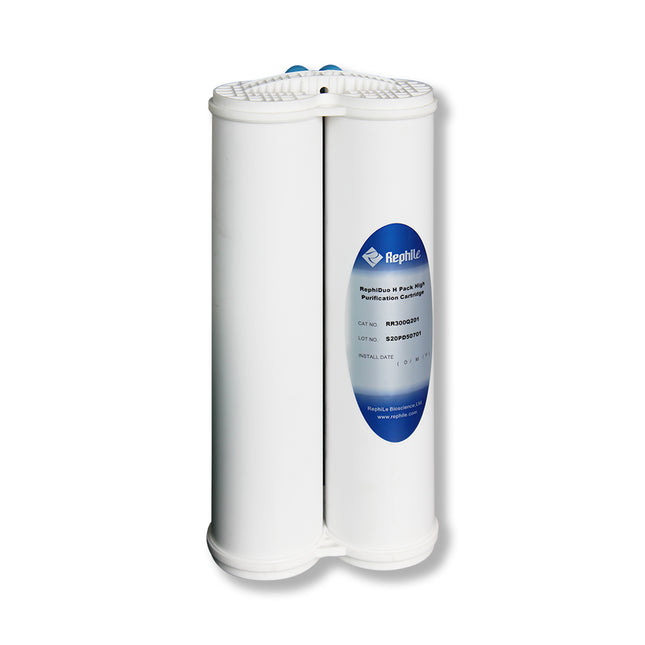
RephiDuo H Pack Cartridge RR300Q201 (1 Count)
SKU: RR300Q201RephiDuo H Pack RR300Q201 is a high-purification pack for Direct-Pure water system to remove ionic impurities from water. Specifications: Burst pressure: ≥15 bar Flow rate: ≥2 L/min(Feed pressure ≥ 2 bar) Height: 331 mm Package Dimensions & Gross Weight Length X Depth X Height (mm): 460 X 220 X 130 Gross Weight (kg): 2.6 Suitable for the following water systems: Direct-Pure UP PURIST Pro
$374.00


